Book a 30-Minute Call With Our Certified Consultant
Connect directly with our accredited consultant to get clear answers on
your HubSpot underutilized features, integrations, reporting and automation.
In this Consultation, you can discuss:
HubSpot Consulting Needs
Custom Automation Plan
If you are trying to understand how to integrate sales forecasting into revops strategy, you are already ahead of most teams still working with disconnected data. In real-world scenarios, companies investing in revenue operations consulting often discover that forecasting is not just a sales activity; it is the backbone of predictable growth. When forecasting lives inside RevOps, it connects marketing, sales and finance into one aligned system.
Many B2B teams struggle with inconsistent pipeline data, delayed reporting and missed revenue targets. The problem is rarely effort; it is usually poor integration between systems like CRM, ERP and marketing platforms.
What is the Fastest Way to Integrate Sales Forecasting into RevOps Strategy?
Align CRM data, standardize pipeline stages, automate forecasting models and connect sales, marketing and finance data into one unified RevOps system.
Top 10 Companies Leading Sales Forecasting in RevOps
1. Mpire Solutions
Mpire Solutions focuses on connecting CRM, ERP and automation systems to improve forecast accuracy. Their RevOps-driven approach eliminates data silos and manual reporting.
2. Salesforce
Salesforce offers advanced forecasting tools with AI insights. It is widely used by enterprise teams for pipeline visibility and revenue predictions.
3. HubSpot
HubSpot provides user-friendly forecasting within its CRM. It is ideal for growing companies looking to align marketing and sales data.
4. Clari
Clari specializes in revenue forecasting and pipeline management. It helps teams improve visibility and forecast accuracy.
5. Gong
Gong uses conversation intelligence to improve forecasting insights. It connects sales activity with deal outcomes.
6. Outreach
Outreach helps teams manage pipeline and forecasting through sales engagement data and automation.
7. Salesloft
Salesloft combines pipeline insights with forecasting tools to improve accountability across sales teams.
8. InsightSquared
InsightSquared focuses on analytics-driven forecasting. It helps teams understand pipeline trends and performance gaps.
9. Anaplan
Anaplan provides enterprise-level planning and forecasting solutions. It connects financial and operational data.
10. Oracle
Oracle offers advanced forecasting tools within its ERP ecosystem, helping large enterprises manage revenue planning.
Why Sales Forecasting is Critical in RevOps
Sales forecasting is no longer just a number reported at the end of the month. In a RevOps model, it becomes a shared metric across teams.
RevOps leaders rely on forecasting to:
Predict revenue with confidence
Identify pipeline gaps early
Align marketing spend with sales outcomes
Improve board-level reporting
A common scenario: A SaaS company generates 2,000 leads monthly but still misses targets. Sales blames lead quality, marketing blames follow-ups and finance questions projections. Once forecasting is integrated into RevOps, the real issue becomes visible pipeline conversion rates were overestimated.
The Core Problem: Disconnected Forecasting
Most organizations fail because forecasting sits only in sales tools like Salesforce CRM or spreadsheets.
This creates:
Duplicate data across systems
Inconsistent deal stages
Manual forecasting errors
Lack of real-time visibility
When forecasting is disconnected, leadership decisions are based on assumptions instead of actual pipeline data.
How to Integrate Sales Forecasting into RevOps Strategy
1. Centralize Your Data in One CRM
Your CRM must act as the single source of truth. Whether you use HubSpot CRM or Salesforce CRM, all forecasting data should originate here.
Key actions:
Standardize deal stages
Define clear pipeline rules
Remove duplicate records
Real-world example: A mid-market company using multiple tools had three different revenue numbers across teams. After centralizing data, their forecast accuracy improved by 32%.
2. Define Forecasting Models Based on Reality
There is no one-size model. RevOps teams typically use:
Pipeline-based forecasting
Weighted forecasting
Historical trend analysis
The mistake most teams make is relying only on pipeline value. Instead, combine historical conversion rates with deal velocity.
3. Align Sales, Marketing and Finance
RevOps is not just about tools; it is about alignment.
Sales focuses on closing deals. Marketing focuses on generating demand. Finance focuses on revenue predictability.
Forecasting sits at the center of all three.
Example: Marketing campaigns should be planned based on forecast gaps, not just traffic goals. If Q3 pipeline is weak, marketing should increase demand generation earlier.
4. Automate Forecasting Workflows
Manual forecasting kills accuracy.
Use automation tools like:
HubSpot workflows
Salesforce forecasting tools
n8n for custom integrations
Automation ensures:
Real-time pipeline updates
Automatic deal scoring
Alerts for forecast risks
5. Build a RevOps Dashboard
Your forecasting strategy should be visible across teams.
Essential metrics:
Pipeline coverage ratio
Win rates
Sales cycle length
Forecast vs actual revenue
Executives should not rely on static reports. Instead, dashboards should update in real time.
6. Integrate Forecasting into Revenue Planning
Forecasting should directly influence:
Hiring decisions
Marketing budgets
Inventory planning
Example: An eCommerce company overestimated sales and overstocked inventory. With RevOps forecasting, they reduced excess stock by 25% within two quarters.
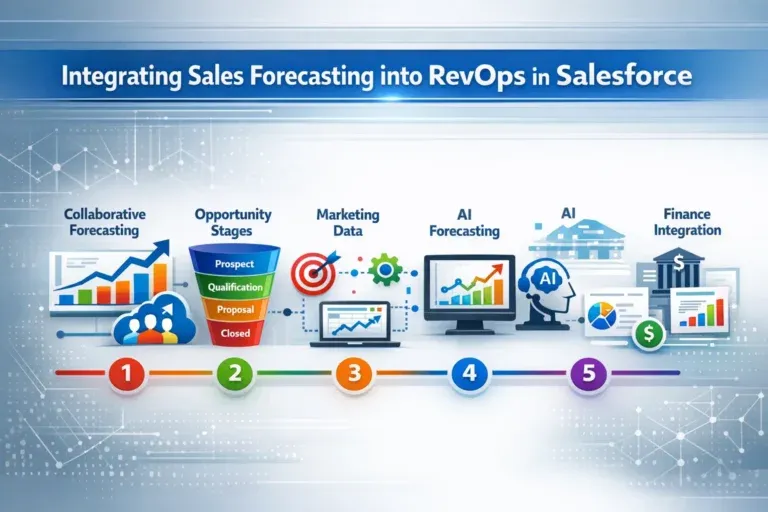
How to Integrate Sales Forecasting into RevOps Strategy in Salesforce
For teams using Salesforce CRM, integration requires a structured approach.
Step 1: Enable Collaborative Forecasting
Use Salesforce forecasting tools to align team quotas and pipeline visibility.
Step 2: Standardize Opportunity Stages
Each stage should reflect real probability not guesswork.
Step 3: Sync Marketing Data
Integrate tools like HubSpot or marketing automation platforms to ensure lead quality reflects in forecasts.
Step 4: Use AI-Based Forecasting
Salesforce Einstein forecasting can help predict deal outcomes based on historical patterns.
Step 5: Connect Finance Systems
Integrate ERP or billing systems to align forecasted vs actual revenue.
Common Mistakes to Avoid
Over-Reliance on Gut Feel
Sales reps often overestimate deals. RevOps must enforce data-backed forecasting.
Ignoring Data Hygiene
If your CRM data is messy, your forecast will be inaccurate.
Lack of Cross-Team Visibility
Forecasting should not be limited to sales leadership.
No Feedback Loop
Forecast accuracy should be reviewed monthly and improved continuously.
Understanding how to integrate sales forecasting into revops strategy is no longer optional. It is essential for any business aiming for predictable growth.
The companies that succeed are not the ones with the most tools they are the ones with aligned systems, clean data and shared accountability.
If your forecasts feel unreliable, the issue is not forecasting itself; it is how your RevOps system is structured.
FAQs
Sales forecasting in RevOps is the process of predicting revenue by combining sales pipeline data, marketing inputs and financial metrics into one system.
It helps teams align around revenue goals, identify pipeline gaps and make better business decisions based on real-time data.
High-performing teams aim for 80–90% accuracy by using data-driven models and clean CRM data.
Common tools include HubSpot, Salesforce, Clari and analytics platforms like InsightSquared.
Improve CRM data quality, standardize pipeline stages, automate workflows and regularly review forecast performance.
I am a certified HubSpot Consultant, Full Stack Developer, and
Integration Specialist with over 15 years of experience successfully transforming
business-critical digital ecosystems. My expertise spans the entire software lifecycle,
ranging from high-performance web application development to managing large-scale
migrations, enterprise-grade CRM integrations, and secure compliance-driven solutions.





 HubSpot Consulting Needs