Book a 30-Minute Call With Our Certified Consultant
Connect directly with our accredited consultant to get clear answers on
your HubSpot underutilized features, integrations, reporting and automation.
In this Consultation, you can discuss:
HubSpot Consulting Needs
Custom Automation Plan
This guide explains how to ensure a seamless HubSpot Salesforce Integration in a way that supports real sales and marketing workflows, not just technical checklists. If your marketing team lives in HubSpot and your sales team works daily inside Salesforce, poor data sync can quickly turn into lost deals, reporting conflicts and internal frustration. This is where HubSpot Salesforce Integration becomes critical for revenue alignment and visibility across the funnel.
After nearly 15 years of implementing and fixing CRM integrations, I have seen that most issues are not caused by tools, but by planning gaps, unclear ownership and incorrect data logic.
How do you ensure a seamless HubSpot Salesforce?
You ensure it by defining data ownership, aligning lifecycle stages, mapping fields correctly, limiting sync rules and testing workflows before activating two-way sync.
Why HubSpot and Salesforce integrations fail in real companies
Most businesses assume integration is a one-click setup. In reality, problems start when teams underestimate how differently both systems treat data.
A common real-world example:
A B2B SaaS sales manager notices duplicate leads in Salesforce after launch. Marketing insists HubSpot is the source of truth, while sales edits records directly in Salesforce. Without ownership rules, both systems overwrite each other.
Typical causes include:
No agreement on which system owns which data
Lifecycle stages not matching opportunity stages
Field mismatches created without validation
Users updating records in both systems at the same time
Understanding these risks early is the foundation of how to ensure a seamless HubSpot Salesforce with Salesforce in production environments.
Define a single source of truth before syncing anything
Before enabling sync, decide which platform controls each data type.
In most revenue teams:
HubSpot owns leads, contacts and marketing engagement
Salesforce owns opportunities, accounts and revenue data
For example, if a sales rep updates a phone number in Salesforce while marketing updates it in HubSpot, which one should win? Without a rule, data conflicts multiply silently.
This step is often skipped, yet it is the most important part of any how to ensure a seamless HubSpot Salesforce guide.
Align lifecycle stages with Salesforce funnel stages
Lifecycle stages in HubSpot and lead or opportunity stages in Salesforce rarely match by default.
Real-life scenario: A marketing-qualified lead is marked as SQL in HubSpot but remains Open – Not Contacted in Salesforce. Reports show inflated conversion rates in marketing dashboards and stalled pipeline in sales forecasts.
Best practice:
Map HubSpot lifecycle stages directly to Salesforce lead or opportunity stages
Avoid creating extra stages unless both teams agree on definitions
Document every stage so new hires follow the same logic
Clear alignment prevents reporting errors and internal disputes.
Map custom fields with business context, not guesswork
Field mapping is where many integrations quietly break.
A finance team once discovered that Annual Revenue in Salesforce was overwriting a manually calculated revenue property in HubSpot. The cause was a rushed field mapping done without validation.
When mapping fields:
Sync only what sales and marketing actively use
Avoid syncing unused or legacy fields
Use one-direction sync for sensitive data like deal value
Proper mapping is a core requirement in any how to ensure a seamless HubSpot Salesforce documentation.
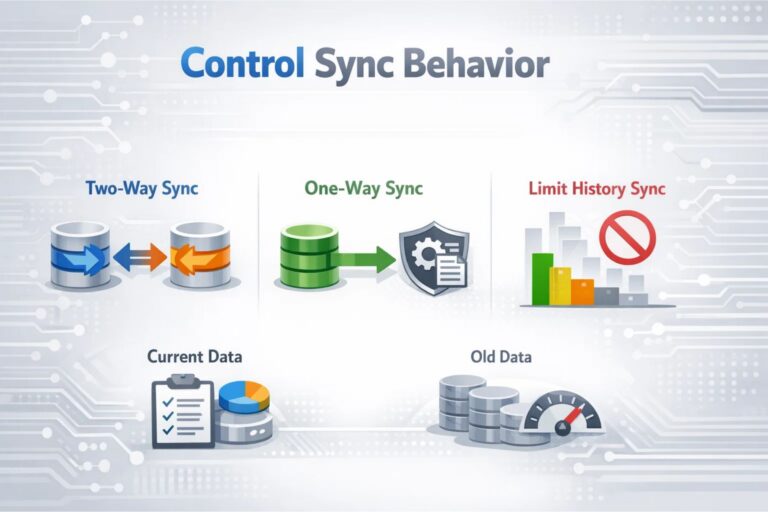
Control sync behavior to prevent data overload
Two-way sync sounds attractive, but it is rarely necessary everywhere.
In practice:
Use two-way sync only for fields updated by both teams
Use one-way sync for calculated, system or compliance-related data
Limit historical data sync to avoid clutter and performance issues
This approach keeps CRMs usable and reporting accurate.
Test integration logic before enabling full sync
Never activate full sync on a live database without testing.
A real example from a services firm: During launch, 40,000 contacts synced incorrectly due to a lifecycle mismatch. Cleanup took weeks and affected active deals.
Testing checklist:
Sync a small batch of records first
Validate ownership rules
Confirm workflows do not loop updates
Review activity timeline visibility for sales reps
Testing reduces risk and builds confidence across teams.
Train sales and marketing teams on integration rules
Even a perfectly configured integration fails if users don’t understand it.
Sales reps often ask:
Why did this field change automatically?
Marketing teams ask:
Why is this lead status wrong?
Training should cover:
Which system to update specific fields in
What not to edit manually
How automation affects records
User education is often missing from technical guides but is essential to long-term success.
Monitor sync health after launch
Integration is not a one-time task.
You should regularly:
Review sync error logs
Check for duplicate records
Audit field changes after CRM updates
Revalidate mappings when processes change
Ongoing monitoring is how mature revenue teams avoid silent data failures.
Then a guided implementation saves time and prevents costly mistakes. At Mpire Solutions, we routinely fix integrations that were technically connected but operationally broken.
Learning how to ensure a seamless HubSpot Salesforce is not about clicking a button. It is about process clarity, data discipline and ongoing ownership. When done correctly, it removes friction between sales and marketing and gives leadership reliable insight into the entire revenue journey.
If your integration feels connected but unreliable, it may be time to revisit the foundation rather than adding more automation on top.
FAQs
Basic setups take a few days, but full production-ready integrations often take several weeks due to testing, field mapping and team alignment.
Yes, but two-way sync should be limited to selected fields to avoid conflicts and data overwrites.
Calculated fields, internal notes, compliance data, and unused legacy fields should usually stay in one system only.
Duplicates often result from missing deduplication rules, mismatched email logic or importing historical data without validation.
Yes, when configured correctly. Clear ownership rules and monitoring are essential as data volume and users increase.
I am a certified HubSpot Consultant, Full Stack Developer, and
Integration Specialist with over 15 years of experience successfully transforming
business-critical digital ecosystems. My expertise spans the entire software lifecycle,
ranging from high-performance web application development to managing large-scale
migrations, enterprise-grade CRM integrations, and secure compliance-driven solutions.





 HubSpot Consulting Needs