Book a 30-Minute Call With Our Certified Consultant
Connect directly with our accredited consultant to get clear answers on
your HubSpot underutilized features, integrations, reporting and automation.
In this Consultation, you can discuss:
HubSpot Consulting Needs
Custom Automation Plan
How Does HubSpot Make Money?
HubSpot is one of the leading CRM platforms globally, known for helping businesses manage marketing, sales and customer service operations in a unified system. Beyond its powerful software features, many wonder how does HubSpot make money and sustain its growth in a competitive SaaS market?
As a certified hubspot agency partner and consultant with over 15 years of experience, I’ve seen firsthand how HubSpot structures its revenue streams. Its business model is a blend of subscription-based software sales, tiered product offerings and professional services that cater to a wide range of industries. Let’s break down how HubSpot revenue machine works.
HubSpot Business Model Overview
HubSpot operates primarily as a Software-as-a-Service (SaaS) company. This means its customers subscribe to use its CRM and marketing tools on a monthly or annual basis. The company revenue model focuses on three core strategies:
Subscription Revenue – HubSpot earns most of its money from monthly or annual fees for its CRM platform and additional hubs.
Professional Services – Paid onboarding, training and consulting services.
Partner Network – Commissions and co-marketing through certified agency partnerships.
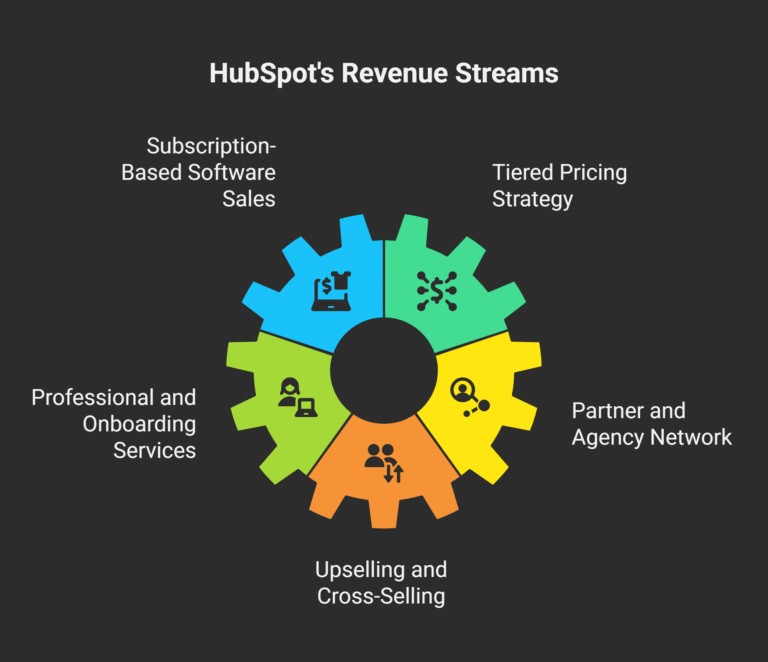
The Core Revenue Streams of HubSpot
1. Subscription-Based Software Sales
The majority of HubSpot income comes from selling subscriptions to its different “Hubs” — each designed to solve specific business needs.
HubSpot Primary Hubs Include:
Marketing Hub – Marketing automation, lead nurturing, analytics and email campaigns.
Sales Hub – Pipeline management, automation and deal tracking.
Service Hub – Customer support ticketing, live chat and knowledge base.
CMS Hub – Tools for managing and optimizing website content.
Operations Hub – Features for data synchronization, automation and reporting.
Every Hub is available in several tiers: Free, Starter, Professional and Enterprise. Customers upgrade to higher tiers for advanced features, increasing HubSpot Annual Recurring Revenue (ARR).
2. Tiered Pricing Strategy
HubSpot boosts revenue by providing pricing tiers that align with a company size and complexity.
Free Tier – Attracts small businesses and startups, allowing them to test the platform.
Starter Plans – Entry-level pricing for growing companies.
Professional Plans – Advanced automation and analytics.
Enterprise Plans – High-level customization, reporting and multi-team management.
This land-and-expand model ensures customers often start small and gradually increase spending as their needs grow.
3. Professional and Onboarding Services
HubSpot also earns money from mandatory onboarding fees for certain plans, especially Professional and Enterprise tiers.
Onboarding fees include setup, technical guidance and initial campaign assistance.
Additional consulting and training services provide recurring revenue and help reduce customer churn.
4. Partner and Agency Network
HubSpot Solutions Partner Program is another significant contributor to revenue.
Certified partners (like agencies) resell HubSpot subscriptions and provide services, earning commissions.
HubSpot benefits through customer acquisition and reduced support costs since agencies handle much of the client onboarding.
5. Upselling and Cross-Selling
Once customers are inside the HubSpot ecosystem, the company strategically encourages upgrades. Examples include:
Adding more seats/users.
Moving from Marketing Starter to Professional or Enterprise.
Purchasing multiple hubs for a fully connected CRM suite.
This upsell strategy drives Customer Lifetime Value (CLV) and strengthens recurring revenue streams.
The Role of Freemium in HubSpot Revenue Model
HubSpot free CRM is a customer acquisition tool. While it doesn’t directly generate revenue, it:
Attracts small businesses with zero-cost entry.
Builds trust and familiarity with the platform.
Converts free users to paid subscribers over time.
This approach lowers Customer Acquisition Cost (CAC) and ensures a steady pipeline of future paying customers.
Revenue Distribution by Segment
According to HubSpot public filings:
Over 95% of revenue comes from subscriptions.
5% or less comes from professional services.
The subscription-heavy model ensures predictable revenue growth and higher profit margins.
Why HubSpot Revenue Model Works
HubSpot ability to scale its customer base and increase revenue per user is built on:
Diverse Product Line – Multiple hubs for different needs.
High Retention Rates – Customers stick with HubSpot once integrated into their workflows.
Partner Leverage – Global agency network reduces marketing costs.
Key Factors Driving HubSpot Profitability
Expanding Global Presence
HubSpot expansion into multiple regions means access to more business markets and enterprise clients.
Continuous Product Development
Regular updates and new features keep customers engaged and prevent churn.
Customer Success Focus
Dedicated support teams and partner agencies help customers achieve measurable results, justifying ongoing payments.
How Much Revenue Does HubSpot Make?
Although the figures change annually, HubSpot growth trend remains remarkable. In recent years, annual revenue has surpassed $2 billion, with subscription sales making up the vast majority. This growth is fueled by both small businesses and large enterprises adopting its platform.
Conclusion
When people ask how does HubSpot make money, the answer is straightforward it’s a blend of subscription software, onboarding services, partner collaborations and upselling. By offering a powerful CRM with scalable features, HubSpot continues to expand its market share and revenue year over year.
If you’re considering implementing HubSpot for your business, working with an experienced hubspot agencies can ensure you get the maximum value from your investment.
FAQs
Q1: How does HubSpot make money from its free CRM? HubSpot uses its free CRM as a lead-generation tool, converting free users into paying customers through upgrades and additional hubs.
Q2: What percentage of HubSpot revenue comes from subscriptions? More than 95% of HubSpot revenue comes from subscription-based sales across its marketing, sales, service, CMS and operations hubs.
Q3: Does HubSpot charge for onboarding? Yes, certain Professional and Enterprise plans require a one-time onboarding fee that covers setup, training and technical guidance.
Q4: Can HubSpot partners earn revenue from the platform? Yes, certified HubSpot agencies earn commissions by reselling HubSpot products and offering implementation services.
Q5: Is HubSpot profitable? HubSpot has shown consistent revenue growth and while it invests heavily in expansion, its subscription model supports long-term profitability.
I am a certified HubSpot Consultant, Full Stack Developer, and
Integration Specialist with over 15 years of experience successfully transforming
business-critical digital ecosystems. My expertise spans the entire software lifecycle,
ranging from high-performance web application development to managing large-scale
migrations, enterprise-grade CRM integrations, and secure compliance-driven solutions.





 HubSpot Consulting Needs