Book a 30-Minute Call With Our Certified Consultant
Connect directly with our accredited consultant to get clear answers on
your HubSpot underutilized features, integrations, reporting and automation.
In this Consultation, you can discuss:
HubSpot Consulting Needs
Custom Automation Plan
Act On vs HubSpot: Complete CRM & Marketing Comparison
When businesses evaluate marketing automation and CRM solutions, two names often surface: Act-On and HubSpot. Both platforms offer strong capabilities for lead management, email automation and customer engagement. However, they differ significantly in usability, ecosystem and long-term value.
As a leading HubSpot Agency, we’ve spent over 15 years guiding organizations through these comparisons. In this article, we’ll break down Act On vs HubSpot (and also consider Act CRM vs HubSpot) so you can decide which platform aligns best with your growth goals.
Act On vs HubSpot: A Quick Overview
What is Act-On?
Act-On is a marketing automation platform designed for businesses seeking advanced email marketing, lead scoring and campaign management. It integrates with popular CRMs but does not provide a native CRM system.
What is HubSpot?
HubSpot is an all-in-one growth platform offering CRM, marketing, sales, customer service and operations tools. Its strength lies in combining automation with a user-friendly CRM, making it easier for teams to unify marketing and sales data.
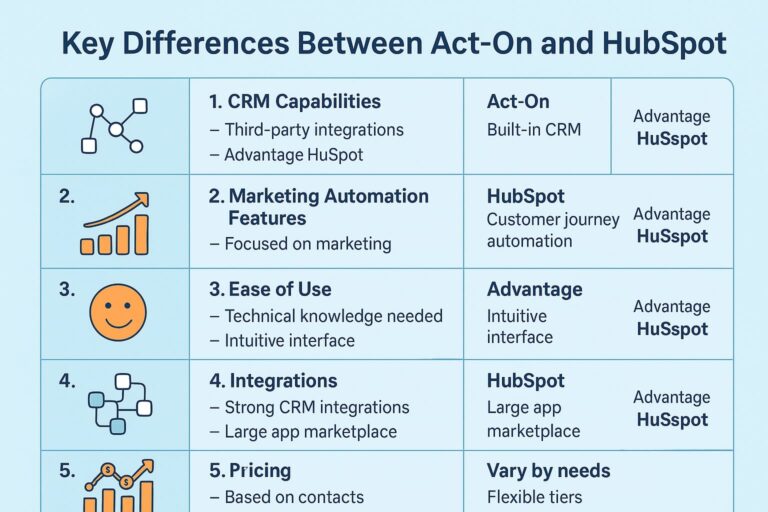
Key Differences Between Act-On and HubSpot
1. CRM Capabilities
Act-On: Relies on third-party CRM integrations such as Salesforce or Microsoft Dynamics.
HubSpot: Comes with a free, built-in CRM that integrates with marketing, sales and service hubs.
Verdict: If your organization wants an all-in-one system, HubSpot offers an advantage by keeping everything in one place.
2. Marketing Automation Features
Act-On: Offers advanced segmentation, automated email campaigns and lead nurturing. It focuses heavily on marketing automation without adding CRM complexity.
HubSpot: Provides automation across the entire customer journey—email workflows, deal stage automation, service ticket routing and more.
Verdict: Act-On is strong for marketing teams; HubSpot wins when multiple departments need connected automation.
3. Ease of Use
Act-On: Requires technical knowledge for setup and optimization. Marketers often depend on IT or dedicated specialists.
HubSpot: Known for intuitive design, drag-and-drop tools and accessible training resources.
Conclusion: HubSpot stands out for businesses that prioritize ease of use and fast adoption.
4. Integrations
Act-On: Strong integrations with Salesforce, Microsoft Dynamics and SugarCRM.
HubSpot: Features a marketplace with 1,500+ apps covering marketing, sales, finance and customer support.
Verdict: HubSpot app ecosystem is broader, making it suitable for businesses needing flexibility.
5. Pricing
Act-On: Pricing is based on the number of active contacts. It can be cost-effective for smaller contact lists but becomes expensive at scale.
HubSpot: Pricing varies by hub (Marketing, Sales, Service, Operations) and tier (Starter, Professional, Enterprise). Free CRM access lowers entry costs.
Verdict: Small businesses with limited contacts may find Act-On affordable but HubSpot offers more long-term scalability and bundled value.
Act CRM vs HubSpot
Some businesses consider Act CRM (not to be confused with Act-On). Act CRM focuses primarily on contact management and sales pipelines. While functional, it lacks the marketing automation power that HubSpot delivers out-of-the-box.
Act CRM Strengths: Contact management, pipeline tracking and integration with Outlook.
HubSpot Strengths: Unified CRM with automation, analytics and advanced reporting for sales and marketing.
If you’re deciding between Act CRM vs HubSpot, HubSpot provides more advanced capabilities and scalability for growing businesses.
Which Platform Should You Choose?
Choose Act-On if: You only need marketing automation and already have a CRM like Salesforce or Microsoft Dynamics.
Choose HubSpot if: You want a single platform for CRM, marketing, sales and service with strong integrations and growth potential.
Conclusion
When comparing Act On vs HubSpot, the choice depends on whether you want standalone marketing automation or a unified growth platform. HubSpot offers broader functionality, a user-friendly CRM and long-term value for businesses investing in customer experience across the entire lifecycle.
Working with an experienced HubSpot Company ensures you maximize your investment by aligning the platform with your unique processes.
FAQs
1. Is Act-On better than HubSpot for email marketing? Act-On is strong in email automation but HubSpot provides email tools integrated with CRM, making campaigns more data-driven.
2. Does Act CRM compete directly with HubSpot? Act CRM covers basic contact and pipeline management but it does not match HubSpot marketing automation and reporting depth.
3. Which is more affordable, Act-On or HubSpot? Act-On may be cheaper for small databases, while HubSpot delivers better long-term value through its free CRM and bundled tools.
4. Can I integrate Act-On with my existing CRM? Yes, Act-On works with Salesforce, Microsoft Dynamics and several other CRMs. However, HubSpot eliminates this need by including its own CRM.
5. Why do companies choose HubSpot over Act-On? Many businesses choose HubSpot for its unified ecosystem, user-friendly interface and ability to scale across marketing, sales and customer service.
I am a certified HubSpot Consultant, Full Stack Developer, and
Integration Specialist with over 15 years of experience successfully transforming
business-critical digital ecosystems. My expertise spans the entire software lifecycle,
ranging from high-performance web application development to managing large-scale
migrations, enterprise-grade CRM integrations, and secure compliance-driven solutions.





 HubSpot Consulting Needs