Book a 30-Minute Call With Our Certified Consultant
Connect directly with our accredited consultant to get clear answers on
your HubSpot underutilized features, integrations, reporting and automation.
In this Consultation, you can discuss:
HubSpot Consulting Needs
Custom Automation Plan
What is Salesforce Commerce Cloud Used For? Everything You Need to Know
If you’re exploring digital commerce platforms, one question that often comes up is: What is Salesforce Commerce Cloud used for? In simple terms, it’s a cloud-based eCommerce solution designed to help businesses deliver personalized, scalable online shopping experiences across multiple channels. From managing storefronts to optimizing checkout, Salesforce Commerce Cloud empowers brands to meet rising customer expectations.
Salesforce Commerce Cloud (previously known as Demandware) is an enterprise-grade eCommerce platform hosted on the cloud. It offers end-to-end solutions for:
B2C commerce – Powering consumer-facing online stores with advanced merchandising, AI-driven personalization, and mobile-first experiences.
B2B commerce – Helping distributors, wholesalers, and manufacturers streamline complex product catalogs, bulk ordering, and contract pricing.
By combining eCommerce, CRM, and AI, Salesforce Commerce Cloud goes beyond just powering websites — it enables unified commerce across digital, mobile, social, and in-store channels.
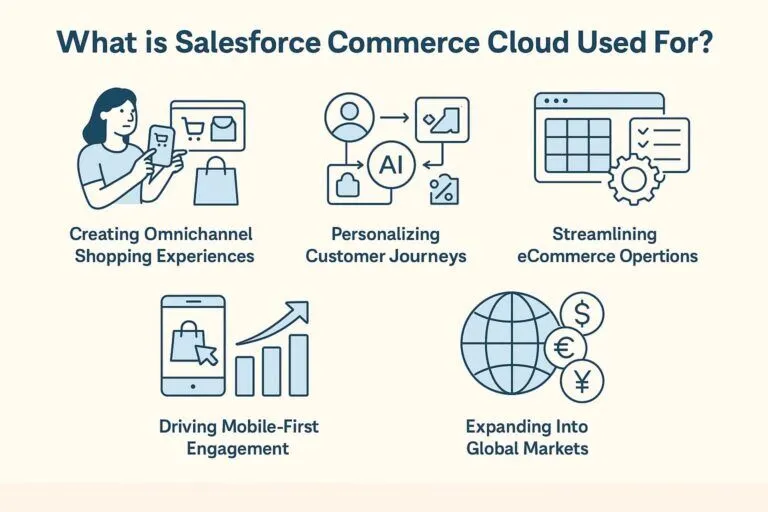
What is Salesforce Commerce Cloud Used For?
1. Creating Omnichannel Shopping Experiences
Today’s consumers expect consistent brand experiences, whether shopping online, on social media, or in-store. Salesforce Commerce Cloud is used to centralize operations across these touchpoints, ensuring unified product data, promotions, and pricing.
2. Personalizing Customer Journeys
With Salesforce Einstein AI, the platform enables advanced personalization. Businesses use it to recommend products, customize promotions, and deliver targeted campaigns based on shopper behavior.
3. Streamlining eCommerce Operations
Commerce Cloud simplifies store management with tools for product cataloging, inventory control, order management, and shipping integration. This reduces manual work while enhancing efficiency.
4. Driving Mobile-First Engagement
The platform is optimized for mobile commerce, allowing businesses to serve customers who increasingly browse and purchase from smartphones.
5. Expanding Into Global Markets
Salesforce Commerce Cloud supports multiple languages, currencies, and localized tax rules, making it easier for enterprises to expand internationally while maintaining compliance.
Key Features That Support Its Use
AI-powered merchandising – Intelligent product sorting, upselling, and cross-selling.
Headless commerce capabilities – Flexible APIs for integrating with apps, websites, and third-party systems.
Integrated order management – Real-time visibility of inventory across warehouses and stores.
Marketing & promotions engine – Built-in tools for discounts, loyalty programs, and campaigns.
Analytics & reporting – Data-driven insights to measure performance and improve decision-making.
Business Use Cases
B2C Enterprises
Retailers leverage Commerce Cloud to deliver personalized shopping experiences, optimize promotions, and manage seasonal sales without worrying about infrastructure limitations.
B2B Organizations
Distributors and manufacturers use it to handle large catalogs, contract-based pricing, and self-service portals for clients.
Direct-to-Consumer (D2C) Brands
Emerging brands use Commerce Cloud to launch online storefronts quickly, with capabilities for personalization and rapid scaling as customer bases grow.
Benefits of Using Salesforce Commerce Cloud
Faster time-to-market with prebuilt frameworks and integrations.
Improved customer engagement through personalization and AI.
Consistent brand identity across multiple digital and physical channels.
Scalability for growth with cloud infrastructure that adapts to demand spikes.
Data-driven decision making using real-time analytics and reporting.
Why Businesses Choose Salesforce Commerce Cloud
Organizations adopt Salesforce Commerce Cloud because it integrates tightly with Salesforce CRM, Service Cloud, and Marketing Cloud. This creates a single ecosystem where customer data drives sales, support, and marketing in real time.
Instead of juggling disconnected systems, businesses manage everything in one place, leading to higher operational efficiency and stronger customer relationships.
How Mpire Solutions Helps
At Mpire Solutions, our consulting team specializes in Salesforce Commerce Cloud Consulting. With years of expertise in digital transformation and enterprise system integrations, we help businesses:
Implement and configure Salesforce Commerce Cloud.
Integrate it with CRM, ERP, and marketing systems.
Provide ongoing support and strategy for long-term success.
Conclusion
So, what is Salesforce Commerce Cloud used for? At its core, it helps businesses deliver personalized, data-driven, omnichannel shopping experiences while simplifying eCommerce operations. From powering global retail giants to enabling ambitious startups, it is a trusted platform for digital commerce success.
If you’re looking to maximize the value of Salesforce Commerce Cloud, Mpire Solutions is here to help you achieve measurable results.
FAQs
1. Is Salesforce Commerce Cloud good for small businesses? Yes. While it’s widely used by enterprises, small and mid-sized businesses can also leverage its cloud-based features to expand online sales without heavy IT costs.
2. What is the difference between B2B and B2C Commerce Cloud? B2C Commerce Cloud focuses on consumer-facing storefronts, while B2B Commerce Cloud handles bulk orders, complex pricing, and distributor relationships.
3. Does Salesforce Commerce Cloud support global expansion? Absolutely. It includes multi-currency, multi-language, and localized compliance features to support cross-border commerce.
4. Can Salesforce Commerce Cloud integrate with ERP or CRM systems? Yes. It offers APIs and connectors for ERP, CRM, and marketing platforms, ensuring a unified digital commerce ecosystem.
5. What industries commonly use Salesforce Commerce Cloud? It is popular in retail, manufacturing, wholesale distribution, fashion, consumer goods, and technology industries.
I am a certified HubSpot Consultant, Full Stack Developer, and
Integration Specialist with over 15 years of experience successfully transforming
business-critical digital ecosystems. My expertise spans the entire software lifecycle,
ranging from high-performance web application development to managing large-scale
migrations, enterprise-grade CRM integrations, and secure compliance-driven solutions.





 HubSpot Consulting Needs